Vinegar and baking soda: what they actually clean (and what they ruin)
Vinegar and baking soda are each genuinely useful cleaners on their own — and nearly useless the moment you mix them together. The satisfying fizz is an acid and a base cancelling each other out into salty water. Separately, though, one dissolves the mineral scale Edmonton’s hard water leaves on everything, and the other scrubs and deodorizes better than most products under your sink. Here is the honest map of where each belongs, from a team that cleans homes for a living.
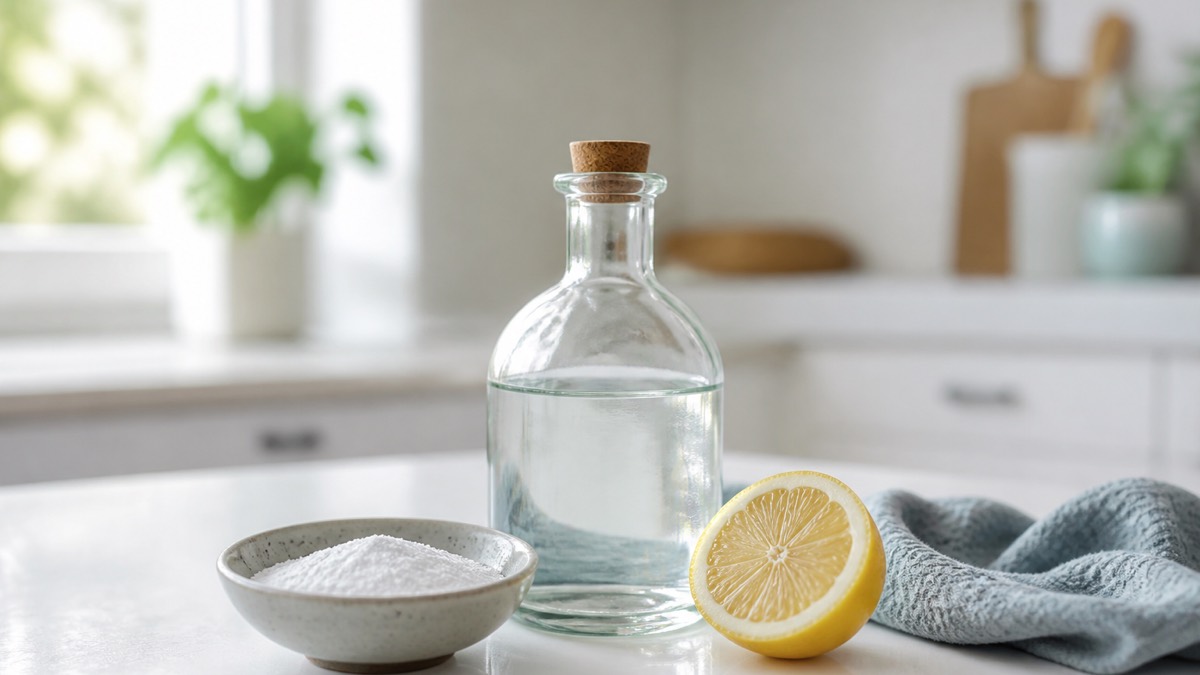
Half the cleaning advice on the internet ends with “just use vinegar and baking soda!” — usually with a video of something fizzing. We use both on real jobs every week, so this guide is the practical version: the chemistry in one paragraph, the tasks where each one earns its keep, and the surfaces where “natural” advice quietly costs people real money.
The chemistry, in one paragraph
Vinegar is a mild acid (acetic acid, about 5%). Baking soda is a mild base. Acids dissolve mineral deposits — hard-water scale, soap scum, rust film. Bases cut grease and absorb odours, and baking soda adds gentle grit for scrubbing. Mix them and they neutralize each other: the fizz is carbon dioxide escaping while your two cleaners turn into sodium acetate and water. The foam looks like it is working hard. It is actually the reaction that just used up both ingredients.
What vinegar is genuinely good at
Edmonton has hard water, which is why every kettle, faucet, and shower door in the city grows white crust. Mineral scale is exactly vinegar’s job:
- Shower heads: unscrew and soak 20 minutes in half vinegar, half water. The spray pattern comes back like new.
- Kettles and coffee makers: fill with the same 50/50 mix, run or boil, rinse very well.
- Faucets and glass shower doors: soak a cloth in vinegar and drape it over the scale for ten minutes before wiping — contact time is what works, not scrubbing.
- Windows and mirrors: a splash of vinegar in water with a good microfibre cloth outperforms most blue sprays, with no perfume haze.
- Dishwasher and washing machine maintenance: an empty hot cycle with a cup of vinegar dissolves detergent scale and film.
What vinegar ruins
This is the part the fizz videos skip. Acid does not know the difference between mineral scale and mineral surfaces:
- Granite, marble, and any natural stone. Acid etches stone — permanent dull spots that no amount of polishing cream fixes. Stone counters get pH-neutral cleaner only, always.
- Hardwood floors. Regular vinegar mopping dulls polyurethane finish over time. Use a cleaner made for sealed wood.
- Unsealed or aging grout. Grout is cement; acid slowly dissolves it. Occasional use on sealed grout is fine — a weekly vinegar habit is how grout lines go crumbly.
- Rubber seals and gaskets. Fridge seals and some dishwasher parts degrade with repeated acid contact. Soap and water there.
- Phone, TV, and laptop screens, which carry coatings that acid strips.
What baking soda is genuinely good at
- A gentle scrub that will not scratch. Made into a paste with water, it cleans stainless sinks, enamel tubs, oven glass, and tea-stained mugs without scouring damage.
- Odour absorption that is real, not perfume. An open box in the fridge, a sprinkle in the bottom of bins, a coat on a musty mattress or rug left for an hour before a thorough vacuum. It absorbs odour molecules rather than covering them.
- The wall behind the stove and greasy cabinet doors, where the mild base cuts cooking film without stripping paint.
- Backsplash grout, scrubbed with a soft brush and paste — the grout-safe alternative to the acid approach.
Where baking soda disappoints
It does not disinfect anything — it has no meaningful effect on bacteria or viruses, so it is not the answer for cutting boards or toilet seats. It leaves a white film if you do not rinse well, which shows brutally on dark counters and stainless. And left wet on aluminum pans or fixtures, it darkens the metal.
About the drain volcano
The most shared trick — baking soda down the drain, vinegar on top, watch it foam — mostly cleans the first five centimetres of pipe, right where you are watching. The reaction neutralizes before it reaches the actual clog, and the fizz has nowhere near the pressure to move hair or grease plugs. Flushing with a kettle of hot water and dish soap does more, a drain snake does most, and an enzyme drain treatment overnight does the rest. We keep the volcano for science fairs.
What our team actually carries
On our carts you will find pH-neutral all-purpose cleaner (safe on stone, wood, and everything between), a dedicated descaler for hard-water jobs where vinegar is too slow, enzyme cleaners for organic messes, and yes — plain baking soda, because for scrubbing a stainless sink there is still nothing better. Clients who prefer green-only products can ask about our eco-friendly cleaning, and vinegar and baking soda genuinely anchor that kit — used separately, on the right surfaces.
The cheat sheet
- Scale, soap scum, cloudy glass: vinegar.
- Scrubbing, odours, grease film: baking soda.
- Stone counters, hardwood, gaskets, screens: neither — pH-neutral cleaner.
- Disinfecting: neither — a proper disinfectant, with the contact time on the label.
- Mixed together: salt water with good marketing.
And if you would rather someone else knows all of this so you do not have to: that is the job. A deep clean resets the scale and grime that DIY products fight, and a recurring clean keeps it from coming back. Request a quote or call (587) 784-6020.
Right products, right surfaces, done for you.